
5 of 10
Transition.
Transition is the change from backswing to downswing. Read its rhythm and direction across several frames; one still cannot show which segment accelerated first.
By Dwain Kinghorn · Updated
The change of direction starts below.
Transition is where the backswing ends and the downswing begins. In these frames the club is still high while the lower body has begun to move toward the target.
Face-on
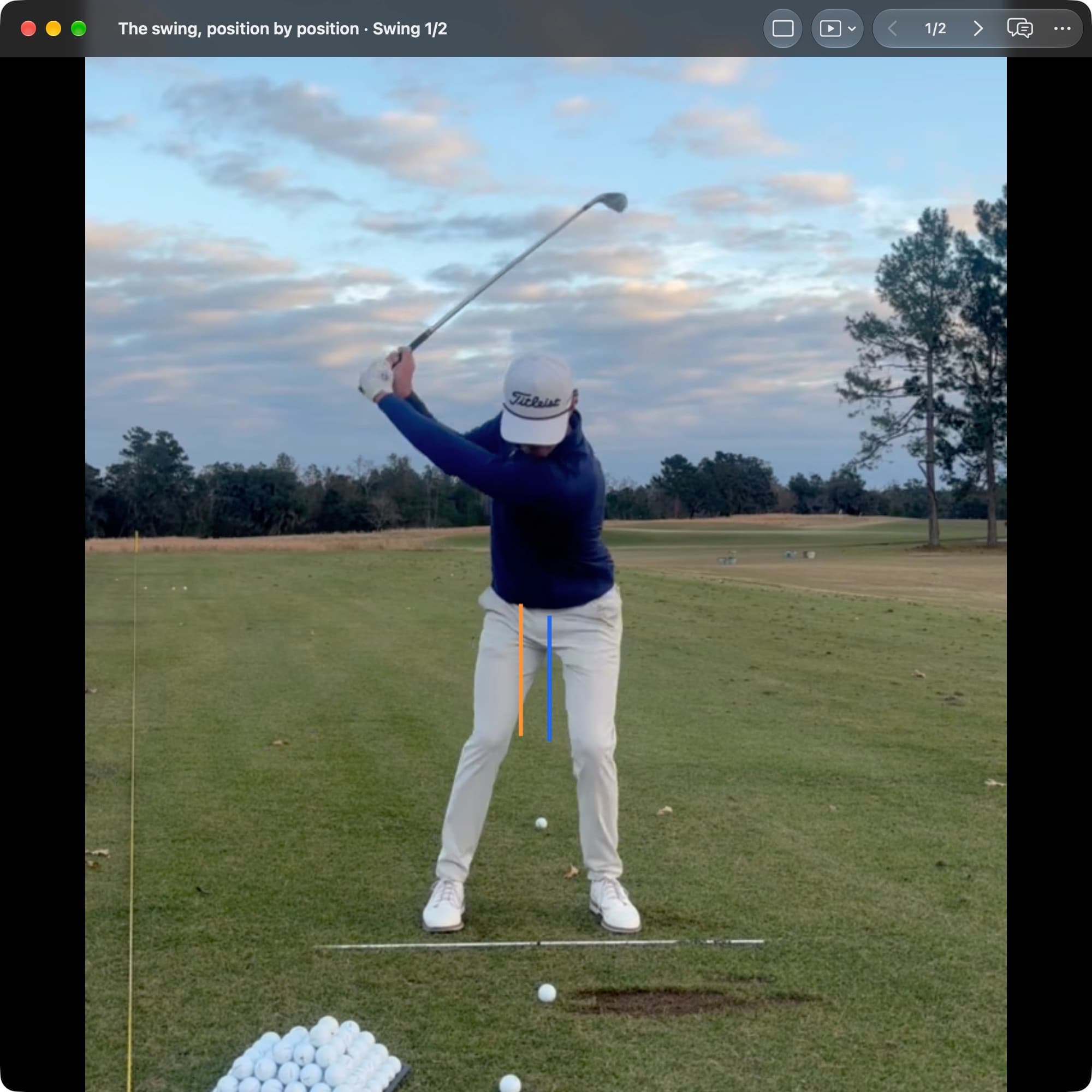

Down-the-line


One frame cannot show which part of the body started down first. Use a short run of frames through Transition to see the direction and rhythm of the change.
Try this view with your own swing
- Choose the frame. Open the swing in Video Player and use Jump to position to select Transition. Step a frame either way to see the motion around it.
- Add a reference. In AI Overlays, turn on both the Setup and Live toggles for Hip Center Line in a face-on recording, or the Live Lead Arm Line in a down-the-line recording.
- Scrub slowly. Step frame by frame from Top into Downswing and watch the lines move, rather than comparing a single still with a model.
Understanding this position.
During transition, the club changes direction while the body reorganizes for the strike. The movements overlap rather than occurring as a row of separate commands. The pelvis can begin moving targetward or turning while the club is still finishing its backswing.
Face-on shows lateral movement and the relationship between the club and body. Down-the-line shows whether the shaft is redirected outward, inward, or along a manageable route. Watch normal-speed playback first to retain the rhythm, then slow the sequence to inspect the path.
How to read the position.
A pause is not compulsory, and a quick transition is not automatically rushed. Some golfers use a brisk change of direction very effectively. Likewise, a visibly shallower shaft is not proof of an improved swing.
The club does not need to fall as far behind the body as possible. Excessive dropping can create a trapped delivery just as an outward throw can create a steep one. Evaluate whether the transition gives the club a usable approach for the intended shot.
Read each camera view.
Face-on
Follow the hands and club as they change direction. Their relationship matters more than demanding that the hands wait for a particular body motion.
What this view can show.
- Hands and club
- Follow the hands and club as they change direction. Their relationship matters more than demanding that the hands wait for a particular body motion.
- Wrist and clubface
- The wrist-and-shaft relationship is changing quickly. Avoid treating a single apparent lag angle as a timing or power measurement.
- Shaft orientation
- Watch the shaft through neighboring frames. A sudden change deserves context from the top and the following downswing before being called a cast.
- Pelvis and space
- Observe the shift toward the lead side and the start of rotation. Some targetward movement is normal; the question is how it blends into delivery.
- Chest and shoulders
- The torso changes its bends and direction as the downswing develops. The head need not stay frozen over its address position.
- Body rotation
- Body segments can change direction at different times. A still describes position, not angular velocity or a measured kinematic sequence.
- Feet and balance
- Feet and knees may move as the golfer uses the ground. Their appearance cannot quantify pressure transfer or identify exact force timing.
Video shows foot movement and balance, not pressure distribution or ground-reaction force.
Down-the-line
Look for a route that leaves the hands and club room to reach the ball. Visibility behind the body alone does not prove the club is stuck.
What this view can show.
- Hands and club
- Look for a route that leaves the hands and club room to reach the ball. Visibility behind the body alone does not prove the club is stuck.
- Wrist and clubface
- If the face is obscured, keep its orientation uncertain. A shaft that shallows does not establish whether the face is correctly arranged for impact.
- Shaft orientation
- Follow whether the shaft tips outward or moves behind the body. The size and consequences of that change matter more than the direction alone.
- Pelvis and space
- Compare pelvis space with Address while allowing for rotation. A large move toward the ball can crowd delivery, but the whole sequence needs review.
- Chest and shoulders
- Observe the torso turn and bend together. Trying to keep the shoulders closed or down indefinitely is not a requirement of this frame.
- Body rotation
- The relationship between chest and pelvis changes continuously. Do not impose a frozen gap or infer exact sequencing from their outlines.
- Feet and balance
- Watch for obvious loss of balance while recognizing that a stable-looking base can still involve large changes in force beneath the feet.
Video shows foot movement and balance, not pressure distribution or ground-reaction force.
Continue through Downswing and Impact. A transition change is useful when it improves the approach, contact, or intended flight without adding strain. A more attractive shaft line alone is incomplete evidence.
If comparing rhythm, include normal-speed playback. If comparing route, keep the down-the-line camera position fixed. Label drill swings separately from normal shots so an intentionally slow rehearsal is not judged as though it were a full-speed attempt.
Watch these clips.
Use these demonstrations to put the still into motion. Each video opens at the selected starting point and continues playing; the note below explains its relevance to this position.
The force-and-motion discussion explains why visible movement is not a direct force measurement. Use it as background for the overlapping transition.
The shift-and-turn rehearsal illustrates a coordinated change of direction. Its exaggerated learning motion is not a required frame-by-frame template for a normal shot.