
Face-on
Hanging back.
Hanging back describes a delivery that stays too far toward the trail side for the intended shot. Separate that pattern from normal upper-body tilt, especially with a driver.
By Dwain Kinghorn · Updated
Face-on · Address, Top, Impact
Upper-body tilt and hip travel can coexist.
In this face-on driver swing, the target is to the right of the picture. Follow the yellow hip arrow toward the target while the cyan torso line tilts away from it. Adam Scott’s upper body can stay behind the ball while the pelvis progresses through the strike.
Swipe across the image to compare Address and Impact.
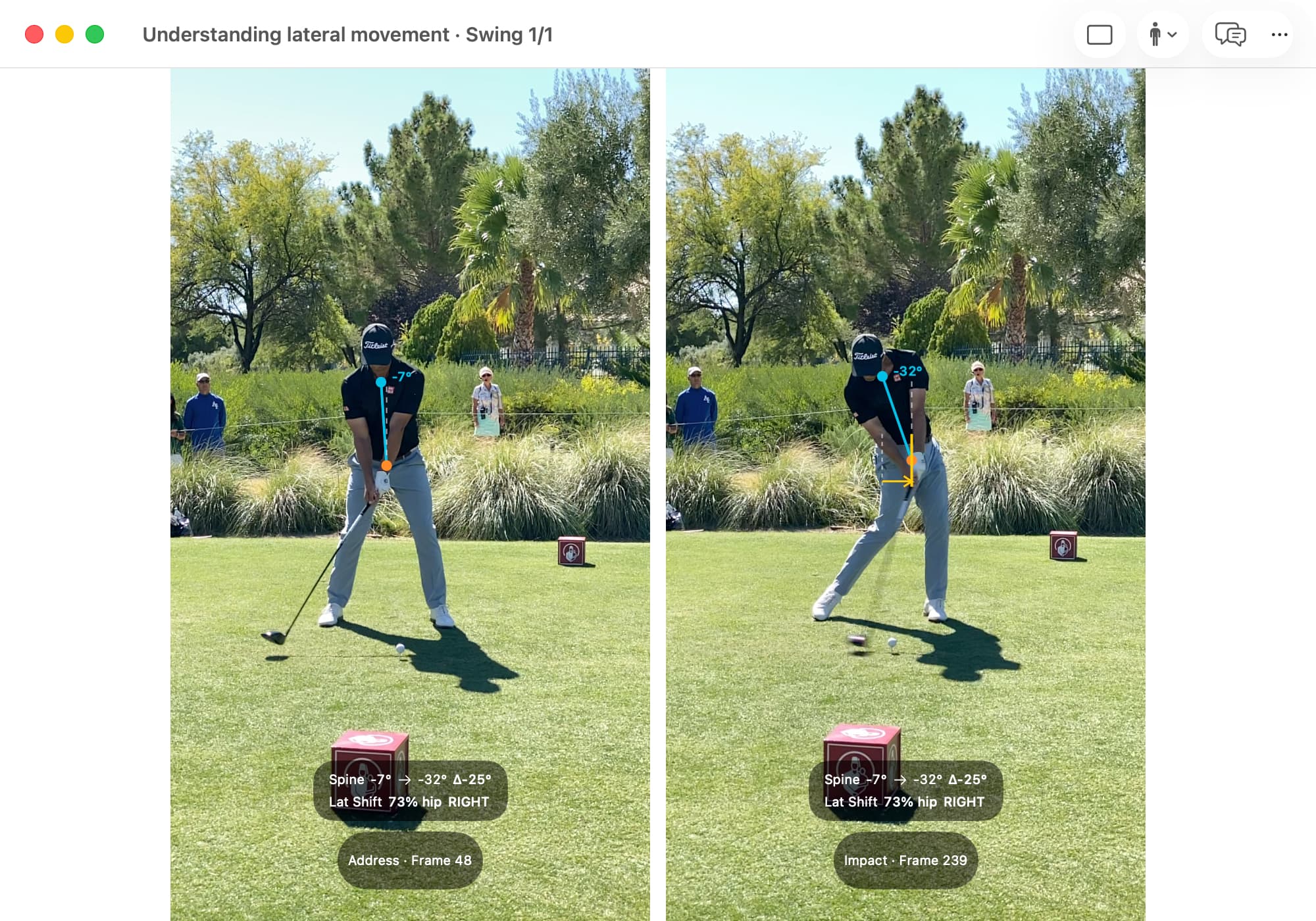
This is a contrast example: upper-body tilt alone is not hanging back. For an iron, follow the delivery in motion and check where ground contact begins. The forward-brush exercise below gives you a visible strike task to pair with that observation.
Try this view with your own swing
- Choose the face-on recording. Open Posture Check. In this view, the hip reference shows lateral movement along the target line, rather than movement toward the ball.
- Check the comparison frames. Use Filmstrip to verify Address and the contact moment. Follow the yellow hip marker and cyan spine line as separate observations.
- Replay through the finish. Return to Video Player and watch Transition through Finish. With an iron, also inspect where the club first touches the ground. A still or a lifted heel does not establish foot pressure.
Understanding the idea.
For a stock mid-iron from the ground, the club normally meets the ball before reaching the bottom of its arc. A swing that falls away from the target or fails to progress through the strike can leave that low point behind the ball. Heavy contact or a thin recovery may follow, although either miss can have other causes.
Face-on video can show whether the body moves through the shot or retreats as impact approaches. Watch the sequence from Transition through Finish, not just whether the trail heel lifts. Heel position is a visible movement; it is not a measurement of how much force either foot applies to the ground.
Hanging back is therefore a working description of a movement and strike pattern, not something a single still proves. Combine the video with the location of ground contact and the intended shot. A soft mat can disguise contact behind the ball, so pay attention to what the club actually touched first.
How to read this pattern.
The head and upper body do not have to pass the ball at impact. Some tilt away from the target is normal, and a teed driver often uses more of it than a mid-iron. Trying to move everything past the ball can create an excessive slide or an unnecessarily steep strike. A grounded trail heel also does not establish hanging back; follow the delivery and the strike.
A practice cue.
Brush the grass beyond the ball and finish facing the target.
Try the exercise.
Forward-brush rehearsal
Start without a ball. Brush the patch, then add a ball at the original position.
- Use a mid-iron on level practice turf. Mark a small brush patch just beyond the intended ball position, toward the target. Begin without a ball and make short swings that brush the patch and continue to a comfortable finish.
- Add the ball at the original position and keep the same modest motion. Swing through the patch rather than trying to lift the ball. If you lunge at the target or chop down to reach the patch, bring it closer and shorten the swing.
- After each shot, check the first ground contact and how you reached the finish. A recovery step is useful feedback; do not hide it by posing afterward. On a mat, use a permitted strike board if available because the surface can disguise contact behind the ball.
What to record
On turf, check whether the first brush or divot starts on the target side of the ball position. Note whether you reach the finish without a recovery step.
Practice set: Make 5 brushing rehearsals, then hit 2 sets of 5 easy mid-irons with a brief balance check after each shot.
Keep in mind: Let the club sweep through the chosen patch toward the target.
Review the result.
For a practice comparison, record 5 full mid-iron swings from a face-on view. Use the same setup for both sets; label shorter drill swings separately.
Compare face-on recordings of similar mid-iron shots. Look for a motion that continues through the ball without a late fall away from the target. Check whether ground contact starts after the ball more often and whether the finish arrives naturally.
Watch these clips.
These demonstrations offer another way to understand the idea. Each video opens at the selected starting point and continues playing; use the note below it to focus your viewing.
The contrast between hanging back and sliding helps show why removing all targetward motion is not the solution. Watch how the movement continues into the strike.
The discussion links lead-side movement and pelvic control with the strike. Use it as context for heavy contact, not as proof that every heavy shot has the same cause.
The shift-and-turn demonstration gives a rhythm reference for moving through the shot. The drill exaggeration is a learning task rather than a required appearance for a normal swing.