
Down-the-line
Spine height.
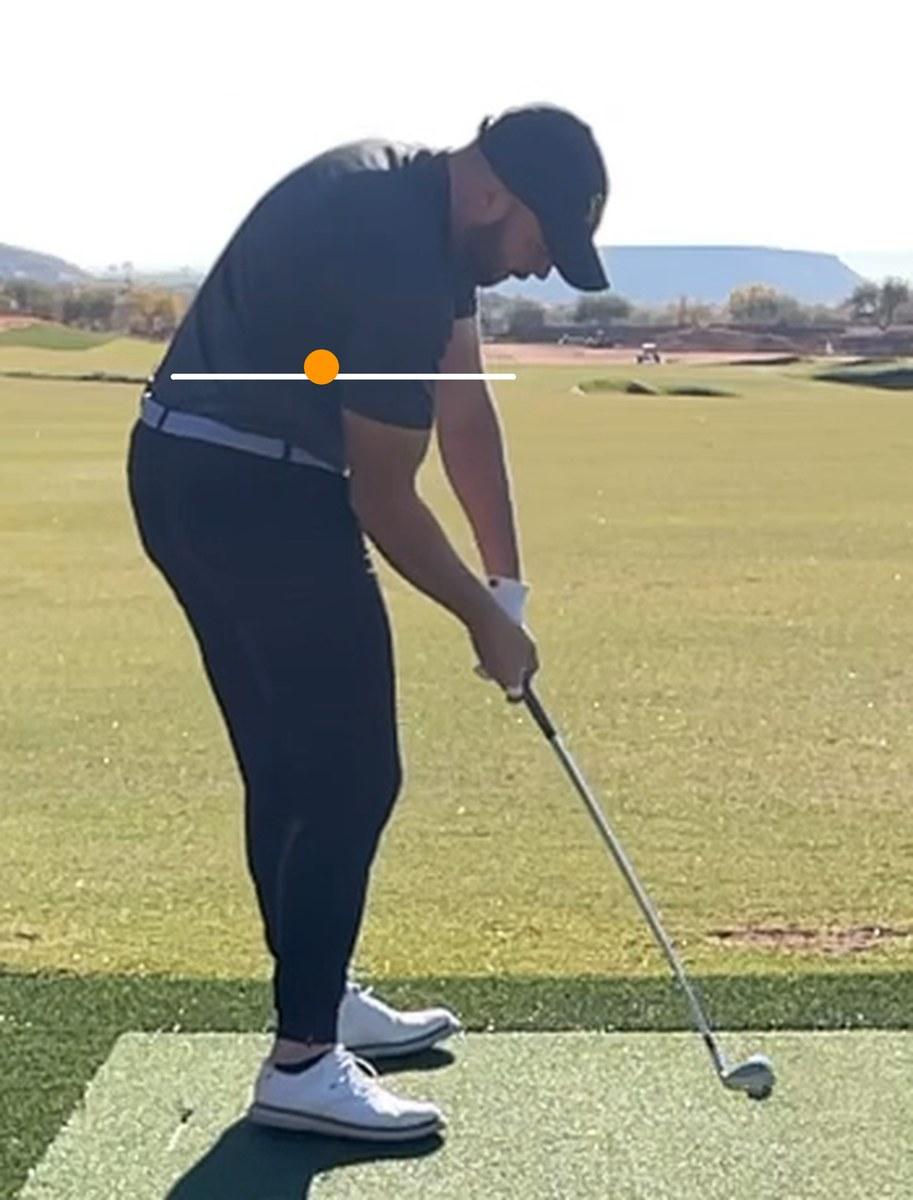
As you turn, spine height tracks the middle of your torso, halfway between shoulders and hips, not your head. A midpoint that rises at the top or coming down often goes with rising out of your posture. Turn in your posture, keeping the same distance from the ball.
By Dwain Kinghorn · Updated
Down-the-line · Address, Top, Impact
What to look for.
- Camera view
- Down-the-line
- Where to pause
- Impact, compared with address
- Picture a level line through the middle of your torso at address, halfway between the shoulders and the hips.
- In this swing, at impact, that midpoint is about on the line, a touch higher.
- A midpoint that has risen well above the line by the top or coming down is what the scorecard describes.
A swing that does this well
Understanding the idea.
Through the swing your torso rises and falls a little as the body turns and the knees change their bend. The scorecard follows the middle of the torso against its height at address and compares it, position by position, with most tour players.
It describes two patterns when they fall outside the tour range. One is a midpoint higher than at address at the top or coming down, which often goes with the body rising out of its posture. The other is a midpoint lower than at address just before or at impact. Some lift into impact is normal.
Read it beside the forward-bend and posture checks. The posture-change pattern on the scorecard puts this height together with the hips and the forward bend.
How to read this pattern.
A little rise or dip is part of a turning swing. Within the tour range, either one is fine.
Don't try to hold your torso at one height. If you lock the height, you usually lock the turn too.
A practice cue.
Turn in your posture, keeping the same distance from the ball.
Try the exercise.
Chair-reference turn
Put a sturdy chair behind you at your address distance from the ball. With no ball, hold a mid-iron across your chest, so the club can't hit the chair, and take your posture so your seat lightly touches it. Make slow turns back and through and keep that light contact as you turn, so your torso doesn't rise away from the chair or sink onto it. The contact can move from one side of your seat to the other. Don't lean on the chair or push it.
Move the chair well out of the way, take your normal grip and repeat at half speed, then add a ball.
What to record
Compare the same frames on a set of ordinary swings before and after practice, and keep a change only when the strike holds up.
Practice set: Make 2 sets of 5 chair turns, then hit 2 sets of 5 easy mid-irons.
Keep in mind: Turn in place, the same height all the way round.
Review the result.
For a practice comparison, record 5 full mid-iron swings from a down-the-line view. Use the same setup for both sets; label shorter drill swings separately.
To check it on your own video, film down the line with the camera fixed and your whole body in the shot. At address, find the point halfway between the middle of the shoulders and the middle of the hips and note its height against something fixed in the background. Step to the top, to halfway down and to impact, and note the same point each time. In a swing that does this well, that midpoint stays close to its address height, maybe a touch higher into impact. A midpoint that has clearly risen by the top or coming down usually goes with losing the forward bend.
Film down the line and compare the middle of the torso at address, the top and impact against a level line. You want a midpoint that stays inside the range, with the forward bend kept and the strike holding up.
Watch these clips.
These demonstrations offer another way to understand the idea. Each video opens at the selected starting point and continues playing; use the note below it to focus your viewing.
How body height changes through impact, with examples of rising out of posture.
Keeping a usable distance to the ball as your body turns, with normal turning and a little lift.