
Face-on
Straight-line release.
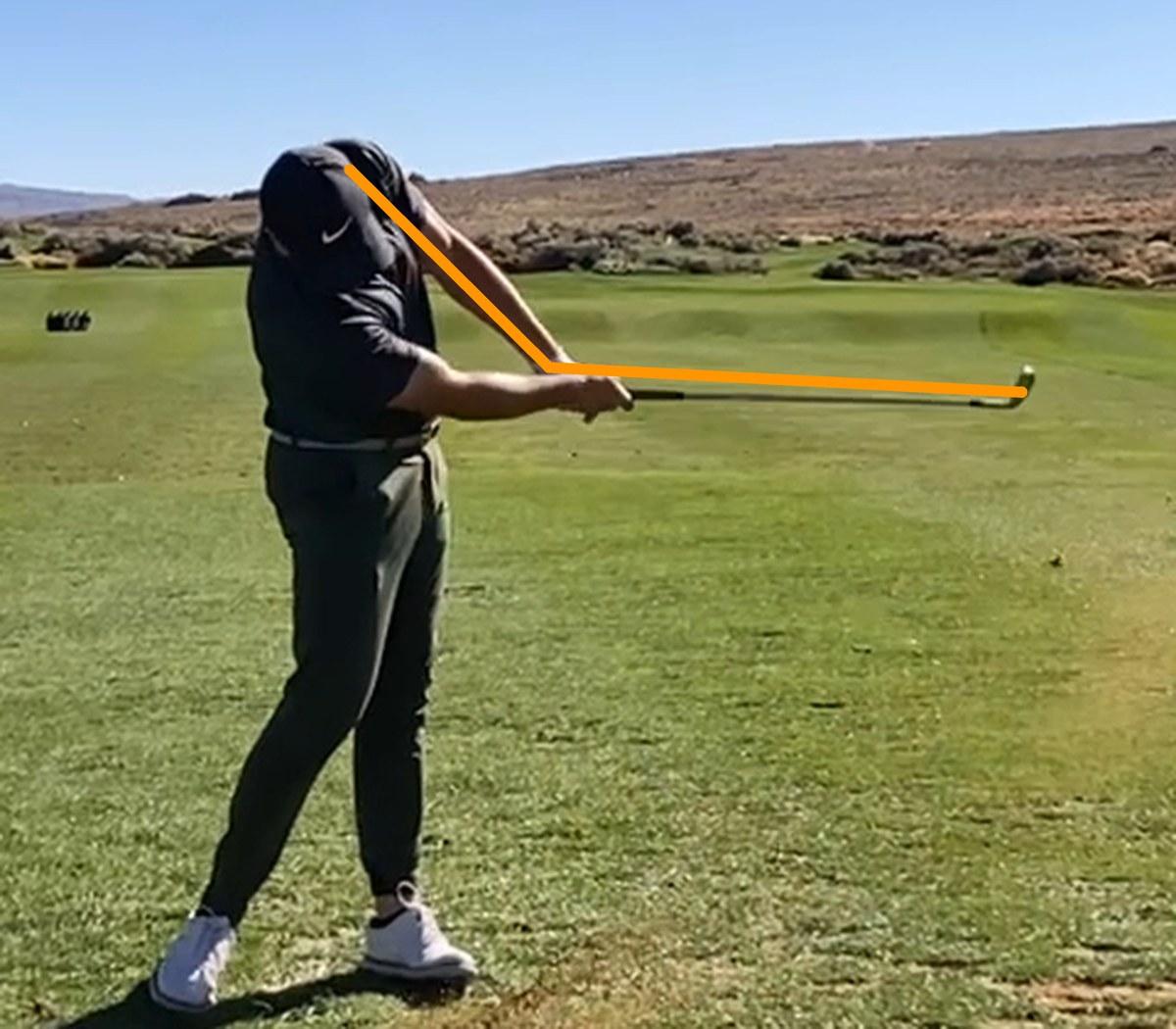
After impact, seen face-on, there's a moment when your shaft and lead arm form one straight line. In most tour swings it comes well after the ball, and reaching it at the ball or before is casting. Let the clubhead pass your hands after the ball, not before it.
By Dwain Kinghorn · Updated
Face-on · Club in frame · Impact, Follow-through, Finish
What to look for.
- Camera view
- Face-on
- Where to pause
- Just after impact, with the shaft about level
- Look at the lead arm and the shaft as the shaft reaches level after the ball.
- In this swing they form about a straight line here, well after the ball.
- A club that lines up with the arms at or before the ball is the early release the scorecard flags.
A swing that does this well
Understanding the idea.
Coming down, the club trails the hands, with an angle between the lead arm and the shaft. That angle lets go through the strike, and at some point after the ball the shaft and the arms form a straight line. The scorecard reads how far past vertical the shaft is when that happens, compared with most tour players.
The flag only goes one way. It catches a club that lines up with the arms sooner after the ball than the tour range. Reaching the straight line at the ball or before it is casting, the early release the early loss of lag guide covers.
Read it after impact, at the shaft level going through, and in the frames on either side.
How to read this pattern.
A soft shot, a chip or a punch releases on a different schedule from a full iron. Within the tour range for the club, a little earlier or later is fine.
Don't try to hold the angle past the ball. Holding on can leave the face open. The release still has to happen.
A practice cue.
Let the clubhead pass your hands after the ball, not before it.
Try the exercise.
Release-after-the-ball rehearsal
Take a mid-iron and make waist-high swings. Stop when the shaft is level after the ball. Check in a mirror or from face-on that the shaft and lead arm form a straight line there.
Keep going until the line shows up after the ball, then hit half shots and three-quarter shots with the same feeling.
What to record
Compare the same frames on a set of ordinary swings before and after practice, and keep a change only when the strike holds up.
Practice set: Make 2 sets of 5 stopped rehearsals, then hit 2 sets of 5 half shots.
Keep in mind: Feel the club catch up with the arms after the ball.
Review the result.
For a practice comparison, record 5 full mid-iron swings from a face-on view, keeping the club in frame. Use the same setup for both sets; label shorter drill swings separately.
To check it on your own video, film face-on, square to the target line, with the club in the shot through the follow-through. Step to impact, then forward one frame at a time. Watch the angle between the lead arm and the shaft and find the first frame where they make a straight line. When a swing does this well, that frame comes after the ball, around where the shaft is level going through. A straight line already at impact, or before it, is the early release the scorecard flags. Look at a few swings, not just one.
Film face-on with the club in the shot and step through from impact. You're looking for the straight line to show up later after the ball, with a solid strike.
Watch these clips.
These demonstrations offer another way to understand the idea. Each video opens at the selected starting point and continues playing; use the note below it to focus your viewing.
The club continuing around after the ball as it releases.
Releasing the club too early in the downswing, the early side of this check.
Face-on, the hands and arms at impact with the club still to release.