
Face-on
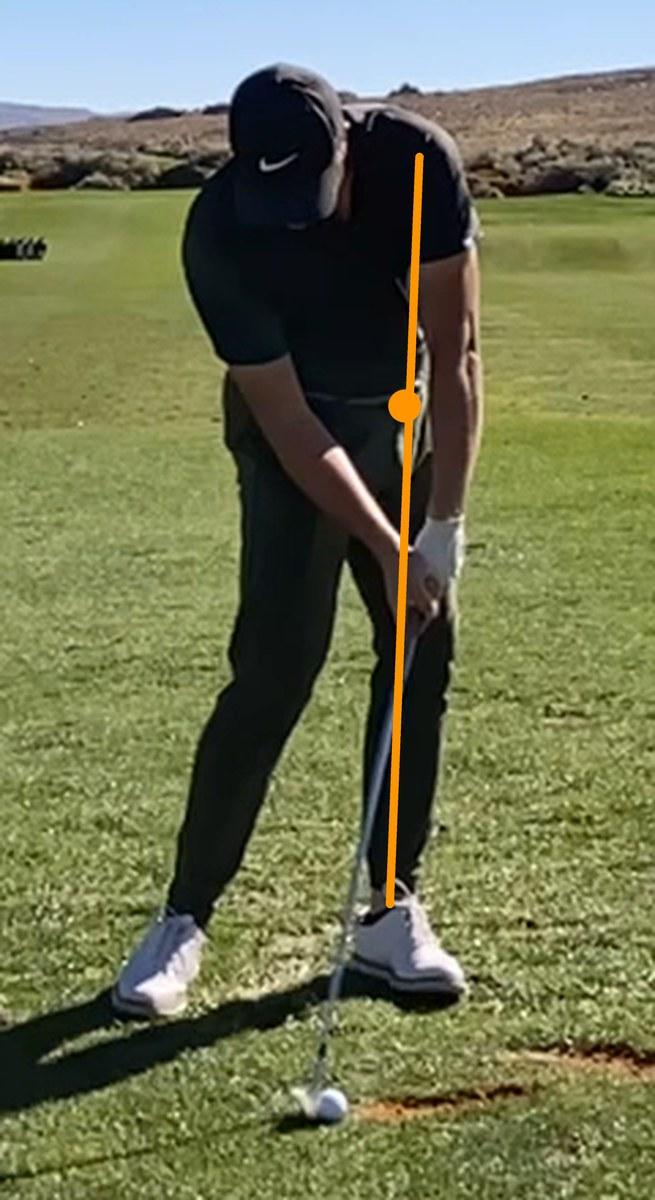
Lead-side line at impact.
At impact, seen face-on, your lead-side line runs from the lead ankle up to the lead shoulder. A lead hip left well behind it is the hanging-back picture, which tends to bottom out behind the ball. Turn through so the lead hip arrives over the lead foot at impact.
By Dwain Kinghorn · Updated
Face-on · Club in frame · Top, Impact, Follow-through
What to look for.
- Camera view
- Face-on
- Where to pause
- Impact
- Picture a line from your lead ankle up to your lead shoulder.
- In this swing, at impact, the lead hip, the dot, sits on that line.
- A lead hip left well behind the line is what the scorecard flags.
A swing that does this well
Understanding the idea.
At impact, in most tour players' swings, the lead hip sits on or a little past the line from the lead ankle to the lead shoulder. The hips lead the upper body toward the target. Lead hip vs lead-side line flags a hip left well behind that line, the hanging back picture. A hip past the line isn't flagged here, because the line leans with the upper body. The shift pattern judges a slide against the lead foot instead.
Lead-side line lean at impact reads the slope of the line itself, with the driver. For most tour players the line leans slightly away from the target at impact, more with the driver than with short irons. The row flags a lean outside their range on either side.
How the line moves from the top into impact is a separate check. The hanging back guide covers it, along with its link to low point.
How to read this pattern.
A line that leans a little away from the target at impact is normal, more so with the driver. A hip a little past the line is normal too. If you're within the ranges, leave it alone.
A practice cue.
Turn through so the lead hip arrives over the lead foot at impact.
Try the exercise.
Lead-side rehearsal
Face a mirror with a mid-iron. A face-on camera works too. Make slow swings that stop at impact. Check that the lead hip has reached the line from the lead ankle to the lead shoulder and hasn't stayed behind it.
Repeat at half speed, then hit balls. With a driver, check the lean of the line too. A little away from the target is the picture.
What to record
Compare the same frames on a set of ordinary swings before and after practice, and keep a change only when the strike holds up.
Practice set: Make 2 sets of 5 stop-at-impact rehearsals, then hit 2 sets of 5 easy shots.
Keep in mind: Feel the lead hip get to the ball before the club does.
Review the result.
For a practice comparison, record 5 full mid-iron swings from a face-on view, keeping the club in frame. Use the same setup for both sets; label shorter drill swings separately.
To check it on your own video, film face-on, square to the target line, with both feet and the club in the shot. Step to impact. Picture a line, or draw one with a line tool, from the lead ankle up to the lead shoulder, and note where the lead hip sits against it. When a swing does this well, the lead hip sits on or a little past the line, toward the target. The line leans slightly away from the target, a little more with the driver. A lead hip clearly behind the line is the picture the scorecard flags. Check the frame on either side of impact too.
Film face-on with the club in the shot and pause at impact. Read the lead-side line and where the lead hip sits against it. You're looking for a hip on or a little past the line, with the strike holding up.
Watch these clips.
These demonstrations offer another way to understand the idea. Each video opens at the selected starting point and continues playing; use the note below it to focus your viewing.
A pelvis well ahead early in the downswing compared with one still behind the ball at that point.
A simple key for impact paired with this guide's picture of the lead side getting there.
How lead-side movement and pelvis control tie in with the strike. It's background. It doesn't prove a single cause.