
Down-the-line
Where the shaft points halfway down.
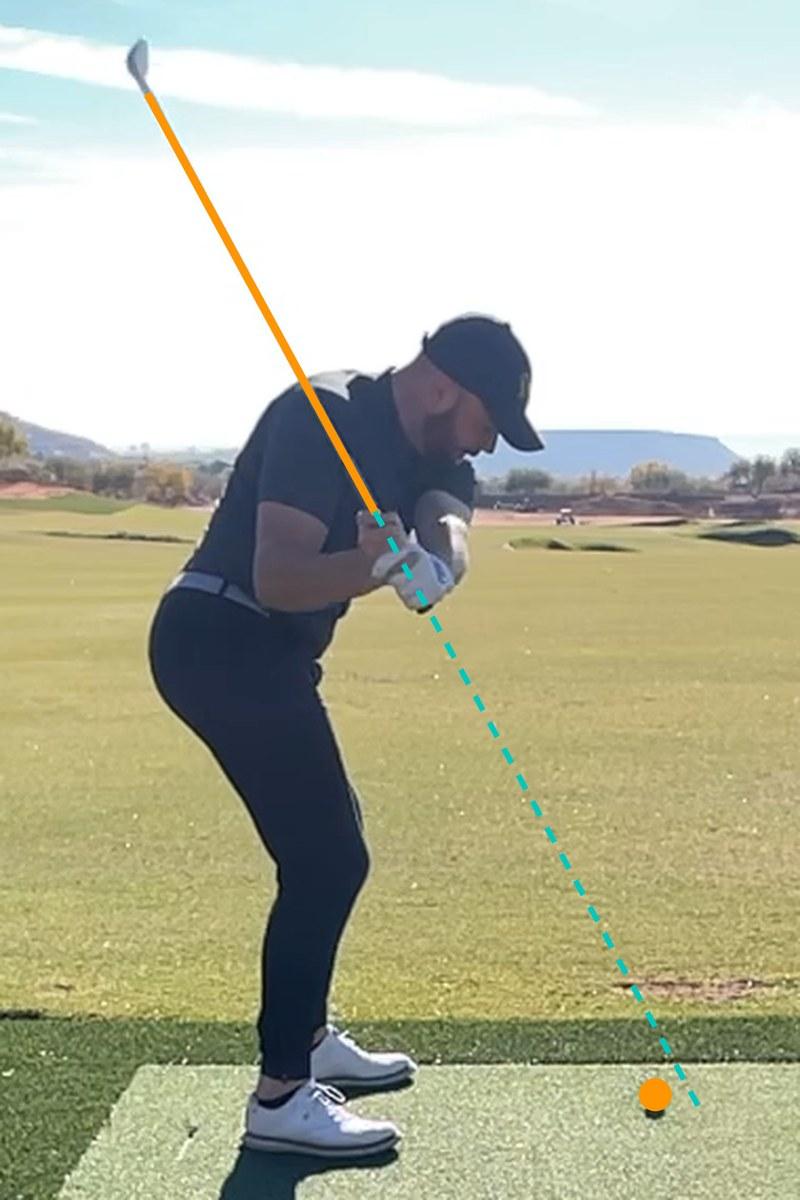
Halfway down, seen down the line, picture your shaft running on to the ground. Pointing well inside the ball means the club has to come up and out to reach it. Most tour shafts point at the ball or just outside, so let the club come down pointing at the ball.
By Dwain Kinghorn · Updated
Down-the-line · Club in frame · Top, Halfway down, Impact
What to look for.
- Camera view
- Down-the-line
- Where to pause
- Halfway down, with your lead arm about level with the ground
- Picture the shaft extended in a straight line down to the ground.
- In this swing it points just past the ball, on the far side from you.
- A shaft that points well inside the ball, toward your feet, is what the scorecard flags.
A swing that does this well
Understanding the idea.
Halfway down, with the lead arm about level with the ground, the shaft is angled toward the ground. Extend it as a straight line and it lands somewhere on the ground: at the ball, just past it, or between the ball and your feet.
The scorecard reads that point. At the ball or just outside it is the common tour picture. A shaft pointing a little inside the ball shows at the edge of the range. Only a clear miss well inside the ball gets flagged. That's the steep end of the downswing, where the club has to come up and out to reach the ball.
It sits beside the check on the clubhead against the address shaft line, which covers the same moment from the clubhead's side.
How to read this pattern.
A shaft that points just outside the ball is common in good swings. A little inside is shown, not flagged. Look at several swings before you decide anything.
A practice cue.
Let the club come down pointing at the ball.
Try the exercise.
Pointer-at-the-ball rehearsal
Lay an alignment stick on the ground just outside the ball, parallel to the target line. With a mid-iron, swing slowly to the top and down to hip height, and pause. Pause halfway down and picture the shaft extended down past your hands toward the ground. See where it points against the target line: at the stick or at the ball.
Repeat until the pause position points at or just outside the ball, then hit half shots with the same feeling.
What to record
Compare the same frames on a set of ordinary swings before and after practice, and keep a change only when the strike holds up.
Practice set: Make 2 sets of 5 paused rehearsals, then hit 2 sets of 5 half-swing mid-irons.
Keep in mind: Feel the club come down on a line that points at the ball.
Review the result.
For a practice comparison, record 5 full mid-iron swings from a down-the-line view, keeping the club in frame. Use the same setup for both sets; label shorter drill swings separately.
To check it on your own video, film down the line with the camera on the target line behind the hands and the ball in the shot. Step to halfway down, with the lead arm about level with the ground. Lay a straight edge or a line tool along the shaft and extend it down past the hands to the ground. In a swing that does this well, that line meets the ground at the ball or just past it, on the far side from you. A line that lands well inside the ball, between the ball and your feet, is the picture the scorecard flags. Check the frames on either side. The point moves quickly.
Film down the line with the club in the shot and pause halfway down. Extend the shaft to the ground. You want a shaft pointing at the ball or just outside it, with the strike holding up.
Watch these clips.
These demonstrations offer another way to understand the idea. Each video opens at the selected starting point and continues playing; use the note below it to focus your viewing.
How the shaft gets steeper or shallower coming down. That's the change this check reads halfway down.
The other side of the picture: a club that drops too far inside and is hard to bring to the ball.
A drill for bringing the club down on a shallower line instead of a steep one.