
Face-on
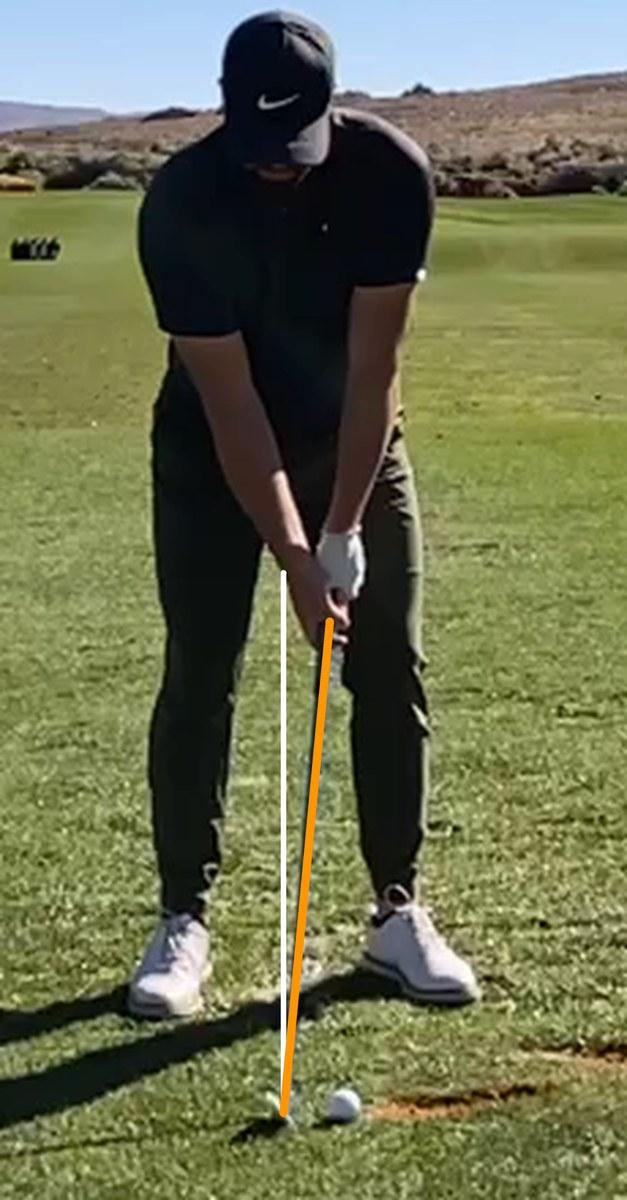
Shaft lean at address.
Before the club moves, look at where your shaft points. Setting your hands well ahead at address to copy impact tends to make the start of the swing awkward. Let the club rest on its sole, with only the slight lean your hands give it.
By Dwain Kinghorn · Updated
Face-on · Club in frame · Address, Takeaway, Impact
What to look for.
- Camera view
- Face-on
- Where to pause
- Address, before the club moves
- Look at the shaft against a line straight up from the clubhead.
- In this setup the hands sit a little toward the target from that line.
- A shaft pressed far forward at address tends to be the impact picture copied too early.
A swing that does this well
Understanding the idea.
Face-on, pause at Address. The shaft leans when the handle sits ahead of or behind the clubhead, so the shaft isn't vertical. With an iron, a little handle-forward is common. The hands hang, the sole sits on the ground, and the shaft points slightly toward the lead side. That quiet lean is what this guide is about.
Ball position is where the ball sits between your feet. You can move the ball without changing the shaft's lean, and you can shove your hands forward without moving the ball. Look at them one at a time. Ball position has its own guide.
No shaft lean is the impact page. Handle-forward at the strike is about the low point and the contact. Setting up that impact picture at address, with the hands pushed ahead before the swing starts, is a different setup and usually an awkward one. Judge the shaft against your body, not the edge of the picture.
Then look at Takeaway. If the shaft was quiet at address and then jerks forward or flips back in the first foot, that's a problem with the start. The address was fine. Glance at Impact only to keep the two moments from blurring together.
Use the same place and the same club when you compare.
How to read this pattern.
Lie angle, hand height and how far you stand from the ball all change the slope of the shaft. An upright club and a flatter one won't match, and a driver won't match an iron. A vertical shaft isn't the correct address. A lot of forward lean isn't more correct. The sole should rest on the ground without your hands forcing it there.
If you already make solid contact, don't borrow the impact lean and set it at address. Setup lean and impact lean are allowed to differ.
A practice cue.
Let the club rest on its sole before it moves.
Try the exercise.
Sole, then start
Take a mid-iron. Sole the club behind the ball so it sits on the ground without your hands pressing the handle forward or pulling it back. Look at the shaft once, face-on, and then leave it. Keep the address where the sole rests.
Make a short takeaway and stop. If the handle jumped forward or the clubhead flipped past your hands in that first foot, set the sole again and start more quietly. Don't fix it by presetting a big forward lean.
Hit easy shots. Keep the ball position the same while you do this, so you're testing the shaft and not the ball. If you start copying your impact hands at address and the strike gets worse, you've mixed up the two pictures. Go back to a resting sole. You have it when the takeaway starts smoothly from a resting sole, shot after shot.
What to record
Describe address before you open the impact frame. A resting sole beats a copied impact pose.
Practice set: 5 sole-and-look setups, then 2 sets of 5 easy mid-irons.
Keep in mind: Let the club sit quiet on its sole until you start it back.
Review the result.
For a practice comparison, record 5 full mid-iron swings from a face-on view, keeping the club in frame. Use the same setup for both sets; label shorter drill swings separately.
Film five full mid-iron swings face-on, with the club in the shot. Pause at Address and ignore Impact until you've described the shaft. Then open Impact and make sure you didn't judge one moment by the other's picture. Shaft Check can draw the shaft line when you want a line to look along. The line is for comparing your own swings. It isn't a number to copy.
Watch these clips.
These demonstrations offer another way to understand the idea. Each video opens at the selected starting point and continues playing; use the note below it to focus your viewing.
They show address with the hands slightly forward and the shaft pointing up toward the lead shoulder, then the different picture at impact. Address and impact stay separate.
This clip is the impact picture, with the handle forward at the strike. Use it as the contrast. The address check on this page is a different moment.