
Launch monitor
Club path.
When the ball starts or curves off line, club path is half the story: the direction your clubhead travels at impact. TrackMan shows it in degrees against the target line, positive in to out, negative out to in. Send the club out along the line you want the ball to start on.
By Dwain Kinghorn · Updated
What to look for.
- Where it comes from
- A launch monitor (TrackMan), not the video
- Where to find it
- The Swing Scorecard's TrackMan rows, on a swing with TrackMan data attached
- Club path is the clubhead's direction at impact: in to out or out to in.
- Most tour swings sit within a few degrees either side of straight.
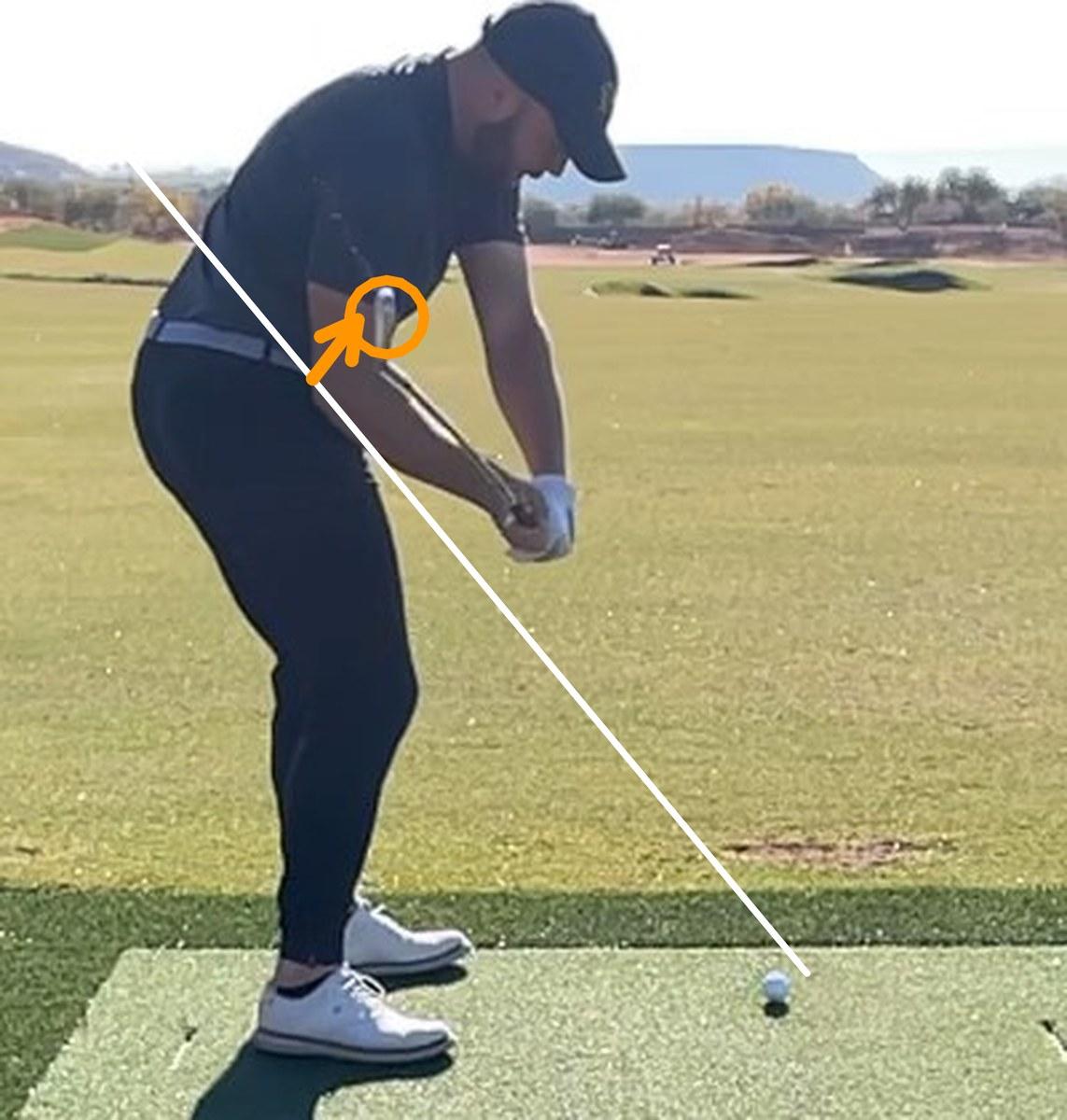
- On video, a clubhead farther above the address shaft line halfway down than most tour players tends to send the path out to in.
What goes with it on video
Understanding the idea.
Path is one of two directions that shape the ball's flight. The other is where the face points. With a centered strike, the ball starts mostly where the face points. It curves away from the path, toward the side the face points compared with the path. The ball flight laws guide puts the two together. In MotionEdge the path number reads the same way for left- and right-handed golfers.
These ranges come from TrackMan: the middle 80 percent of the tour swings MotionEdge has for that club. They show where good players land. They aren't a number to aim for. With irons, most tour swings have a path between about 4 degrees out to in and 4 degrees in to out, with the middle close to straight. Wedges are similar. With the driver, between about 5 degrees out to in and 4 in to out.
On video, the downswing picture the cause map ties to path is the clubhead against the address shaft line halfway down. A clubhead farther above that line than most tour players tends to send the path out to in. Farther under it tends to send it in to out.
How to use this idea.
A draw uses a path a little in to out, and a fade a little out to in. Neither one is wrong. What counts is whether the path, together with the face, gives you a start and curve you can play.
A practice cue.
Send the club out along the line you want the ball to start on.
Try the exercise.
Path window
On a launch monitor, set two alignment sticks or headcovers to make a gate a little in front of the ball, angled along the path you want. Hit five shots through it and note the club path of each.
Move the gate a little to change the path and hit five more. Watch the path number and the ball's start and curve together.
What to record
Compare the average of each set with the same club, and keep a change only when the number repeats and the strike holds up.
Practice set: Hit 3 sets of 5, noting club path, start and curve for each ball.
Keep in mind: See the clubhead pass between the gate posts on the line you chose.
Review the result.
Compare path averages with the same club. You're looking for a path that changes less from shot to shot and fits the shape you play.
Watch these clips.
These demonstrations offer another way to understand the idea. Each video opens at the selected starting point and continues playing; use the note below it to focus your viewing.
Path, face angle and face to path defined on TrackMan, then read shot by shot.
A simple way to picture the club's path through impact.