
Down-the-line
Hands at the top.
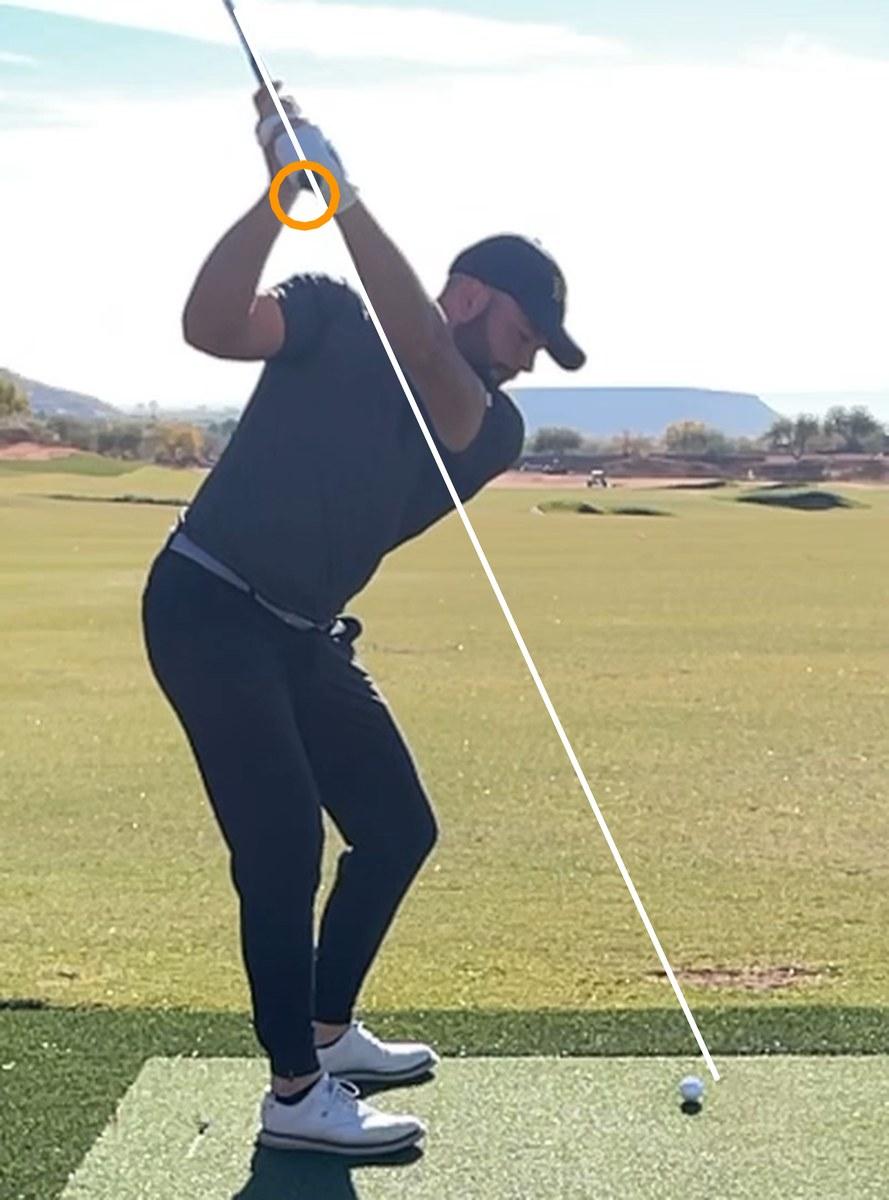
At the top, check your hands against the shoulder plane, a line from the ball up through your shoulders at address. Hands well above it make a steep, upright top, and most tour players' hands sit on it or under it. Let your hands finish the backswing behind your trail shoulder.
By Dwain Kinghorn · Updated
Down-the-line · Halfway back, Top, Transition
What to look for.
- Camera view
- Down-the-line
- Where to pause
- The top of the backswing
- Picture a line from the ball up through your shoulders at address: the shoulder plane.
- In this swing the hands, circled, finish about on that line.
- Hands well above the line are what the scorecard flags. Hands under it are only described.
A swing that does this well
Understanding the idea.
The shoulder plane is a line from the ball up through the shoulders at address. At the top, most tour players' hands sit about on that line or under it.
The hands at the top row is flagged when the hands sit higher above the shoulder plane than most tour players' do. That's a steep, upright top. The hands below shoulder plane at top row is shown and never called good or bad. Many tour players' hands sit under the line, and the row only describes it when your hands are farther under than theirs.
Read the hands with the shoulder turn. Hands well above the line with a small turn means the arms lifted and the body didn't turn much.
How to read this pattern.
Hand height at the top varies with build and the club. Upright tops and flatter tops both win tournaments. Within the range, look at the downswing that follows. The top alone won't tell you much.
A practice cue.
Let the hands finish the backswing behind your trail shoulder.
Try the exercise.
Shoulder-plane check
Set a camera down the line. Take your address with a mid-iron and note the line from the ball up through your shoulders. Swing slowly to the top and hold.
Check your hands against that line. Make rehearsals that let the hands finish behind the trail shoulder instead of lifting above it, then hit half shots. You have it when your hands finish on or under the line on most swings.
What to record
Compare the same frames on a set of ordinary swings before and after practice, and keep a change only when the strike holds up.
Practice set: Make 2 sets of 5 held rehearsals, then hit 2 sets of 5 half-swing mid-irons.
Keep in mind: Let your hands turn in behind your trail shoulder instead of lifting up.
Review the result.
For a practice comparison, record 5 full mid-iron swings from a down-the-line view. Use the same setup for both sets; label shorter drill swings separately.
To check it on your own video, film down the line with the camera on the target line behind the hands, at about hand height. At address, picture a line from the ball up through the middle of your shoulders, or draw it with a line tool. Step to the top and look at your hands against that line. In a swing that does this well, the hands sit about on the line or a little under it, behind the trail shoulder. Hands well above it, high over the head, are what the first row flags. Hands far under it are what the second row describes.
Film down the line and pause at the top. Compare your hands with the shoulder plane. You want hands about on or under the line, with an unhurried downswing after it and the strike holding up.
Watch these clips.
These demonstrations offer another way to understand the idea. Each video opens at the selected starting point and continues playing; use the note below it to focus your viewing.
How deep the hands get as the body turns. That's the picture this check reads at the top.
Looking at a top position in practice, with comfort and the transition that follows in mind.