
Down-the-line
Shoulder turn.
At address, seen down the line, your shoulders look narrow. As you turn back, the line across them looks wider, and a line that stays narrow can go with less club speed. Turn your back to the target before the club starts down.
By Dwain Kinghorn · Updated
Down-the-line · Address, Top, Transition
What to look for.
- Camera view
- Down-the-line
- Where to pause
- The top of the backswing, compared with address
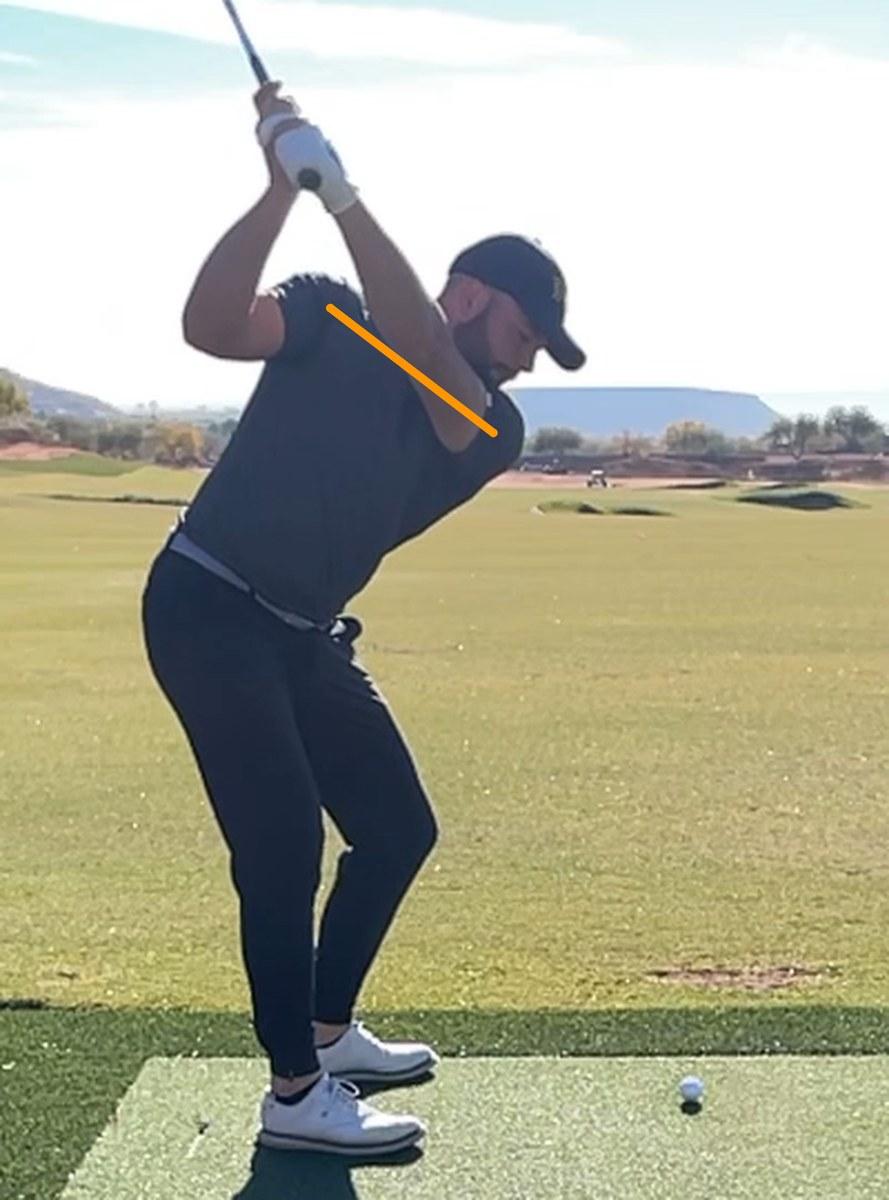
- Look at how wide the line across your shoulders looks.
- In this swing, at the top, the line is wide because the back has turned toward the camera.
- A shoulder turn that stays small by the top and less club speed are often seen together.
A swing that does this well
Understanding the idea.
Seen down the line, you're side-on, so at address the two shoulders almost overlap. As the shoulders turn back, the trail shoulder moves behind and the line across them opens up in the picture. The scorecard compares that width at the top with most tour players' and flags it only when it stays narrower than their range. Beside it, the scorecard shows how far the hands rose, which is the arm side of the same turn.
You'll often see a shoulder turn that stays small by the top together with less club speed. That's a pattern across many swings. It doesn't promise that a bigger turn adds speed for every golfer.
A small turn can come from limited mobility, a short swing you chose, or the arms doing the work. Read the turn with the hands. Hands at full height with a small turn is the arm-dominant picture.
How to read this pattern.
Flexibility, age and the club all change how far the shoulders turn. A turn at the low end of the tour range is still a full turn.
Don't force more turn than your body allows. If you overturn by letting the hips swing far around, or by bending the lead arm, the turn looks bigger and gets harder to repeat.
A practice cue.
Turn your back to the target before the club starts down.
Try the exercise.
Back-to-target rehearsal
Take your address with a mid-iron and no ball. Turn back slowly until your back faces the target as far as is comfortable, keeping your forward bend. Hold for a moment, then swing through to a finish.
Repeat at half speed, then add a ball. If the lead arm bends or the trail knee straightens to make the turn bigger, stop at the turn you can make without them.
What to record
Compare the same frames on a set of ordinary swings before and after practice, and keep a change only when the strike holds up.
Practice set: Make 2 sets of 5 slow turns, then hit 2 sets of 5 easy mid-irons.
Keep in mind: Feel the back turning to face the target.
Review the result.
For a practice comparison, record 5 full mid-iron swings from a down-the-line view. Use the same setup for both sets; label shorter drill swings separately.
To check it on your own video, film down the line at about hand height with your whole upper body in the shot. At address, note how narrow the line across your shoulders looks. From down the line, the two shoulders nearly overlap. Step to the top and look again. In a swing that does this well, the shoulder line has opened up across the picture, with the back turned to the target and the forward bend kept. Look at the hands at the same time. Hands at full height with a narrow shoulder line means the arms lifted and the body didn't turn much.
Film down the line and compare address with the top. Look at how wide the shoulder line appears. You want a wider line at the top, with the forward bend kept and the strike holding up.
Watch these clips.
These demonstrations offer another way to understand the idea. Each video opens at the selected starting point and continues playing; use the note below it to focus your viewing.
Turning in the backswing, kept apart from drifting sideways. That's the turn this check reads.
Turning the upper body and hips into a braced trail leg instead of sliding.