
Face-on
Where distance comes from.
If you want more distance, the strike usually has more to give than a harder swing. A ball off the toe or heel leaves slower, so a smooth, centered strike often outflies a full-effort mishit. Find the middle of the face first, then look at speed and launch.
By Dwain Kinghorn · Updated
Face-on · Club in frame · Halfway down, Pre-impact, Impact
What to look for.
- Camera view
- Face-on
- Where to pause
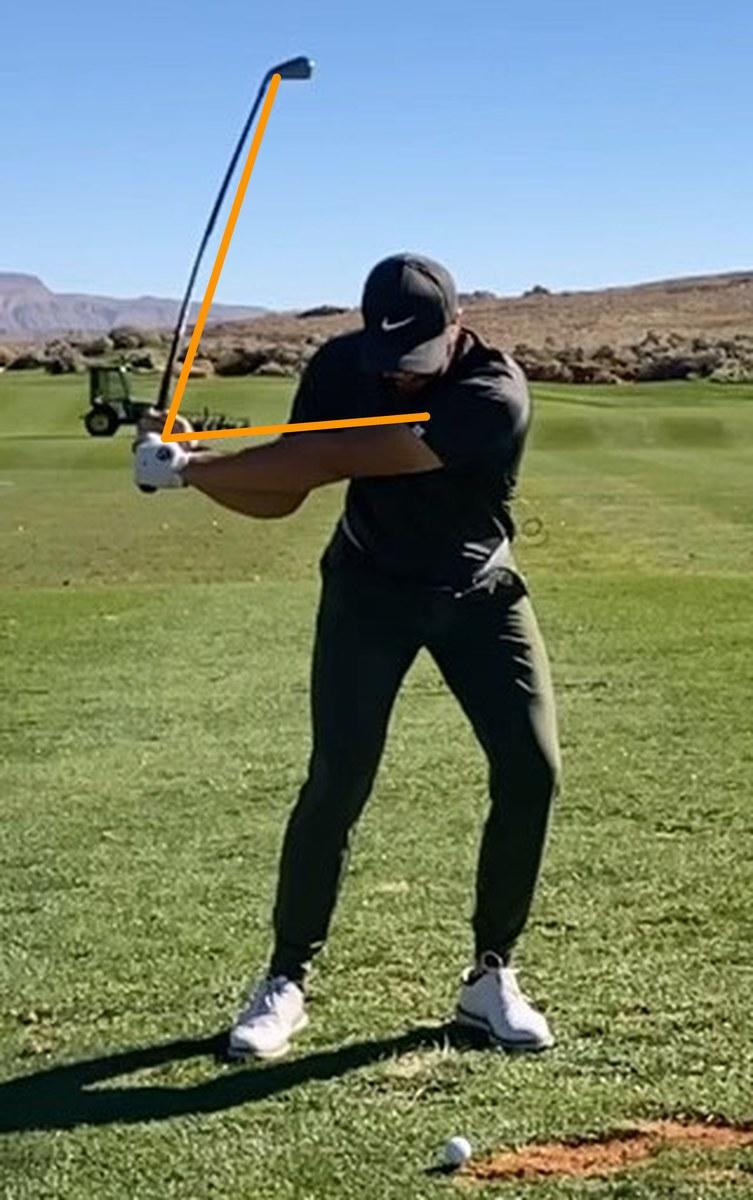
- Coming down, with your lead arm about level with the ground
- Check the strike first: impact tape or a face spray shows where the ball meets the face.
- Then look at the angle between your lead arm and the club. In this swing it's still folded.
- That angle opening early tends to cost a little clubhead speed. It is one piece of distance, not all of it.
A swing that does this well
Understanding the idea.
Club speed sets the ceiling. A faster club can give the ball more speed, but only when the ball meets the middle of the face. A strike toward the toe or heel sends the ball off slower at the same club speed. So a well-struck shot at a smooth pace often flies farther than a mishit at full effort.
Launch is the third piece: the angle the ball leaves at and how much it spins. With a driver, a strike that meets a teed ball slightly on the way up tends to launch higher with less spin. That usually carries farther than one that hits down on it. With irons, the loft of the club does most of the launching, and a ball-first strike lets the loft do its job.
In the swing itself, one picture MotionEdge measures face-on is the lag angle, the angle between the lead arm and the club coming down. In swings with more clubhead speed, that angle tends to stay folded until the lead arm is about level with the ground. Letting it open early tends to cost a little speed. That's one modest link. Body turn, strength, mobility and equipment matter too.
Before you chase speed, look at the strike. If the marks are scattered, start with the off-center strike guide. If the strike is centered and the ball still comes up short, look at speed and launch next.
How to read this pattern.
Shorter doesn't mean wrong. Distance depends on age, strength, mobility and equipment, and golfers who swing at very different speeds can all strike the ball well. Good players come in a range too, and plenty of them aren't long.
Swinging harder often backfires. Extra effort tends to scatter the strike, and a scattered strike gives back the speed it added. Losing distance lately is a different question from always being short. A change in equipment, fitness or contact is more likely than a sudden change in swing speed.
A practice cue.
Strike the middle of the face at a pace you can repeat.
Try the exercise.
Three-pace carry test
Take a mid-iron or a driver to a spot where you can see where the ball lands, or use a launch monitor if you have one. Spray the face or use impact tape so every strike leaves a mark.
Hit five balls at an easy pace, five at a medium pace and five at full effort. After each ball, note the strike mark and roughly where it landed. Don't change anything else between the sets.
Compare the three sets. If the medium set lands about as far as the full one with more centered marks, build from that pace, because it keeps the strike. If the full set is both longer and centered, speed isn't what's holding you back. Look at launch next.
What to record
For each pace, note the strike marks and the landing spots. Keep the pace that gives the longest centered strikes, not the longest single ball.
Practice set: Hit 3 sets of 5 balls at easy, medium and full pace, noting the strike mark and landing spot of each.
Keep in mind: Swing at the pace that leaves the spray mark in the middle of the face.
Review the result.
For a practice comparison, record 5 full mid-iron swings from a face-on view, keeping the club in frame. Use the same setup for both sets; label shorter drill swings separately.
Judge distance on centered strikes with the same club and target. Compare the average over a set. Your one longest ball doesn't tell you much. Face-on, pause coming down when the lead arm is about level with the ground and look at the angle between the lead arm and the club across several swings.
A more folded angle there with a centered strike is useful. A more folded angle with scattered marks isn't a gain yet.
Watch these clips.
These demonstrations offer another way to understand the idea. Each video opens at the selected starting point and continues playing; use the note below it to focus your viewing.
The attack-angle examples show how a different way of hitting the driver can change how far it can go. Look at launch, spin and strike together. Don't chase one number.
The strike discussion treats contact location as part of a good impact. A centered strike is where club speed turns into ball speed.
The sequence explanation is background on how a swing builds speed with the parts working together. Don't turn the order into a set of commands you time during the swing.