
Down-the-line
Toe strike.
Out on the toe, an iron feels dead and the ball comes up short. This is common, and the club has likely come back closer to you than it started. Set a tee just inside the heel and return the middle of the face to the ball without clipping the tee.
By Dwain Kinghorn · Updated
Down-the-line · Address, Impact, Follow-through
What to look for.
- Camera view
- Down-the-line
- Where to pause
- Impact, compared with address
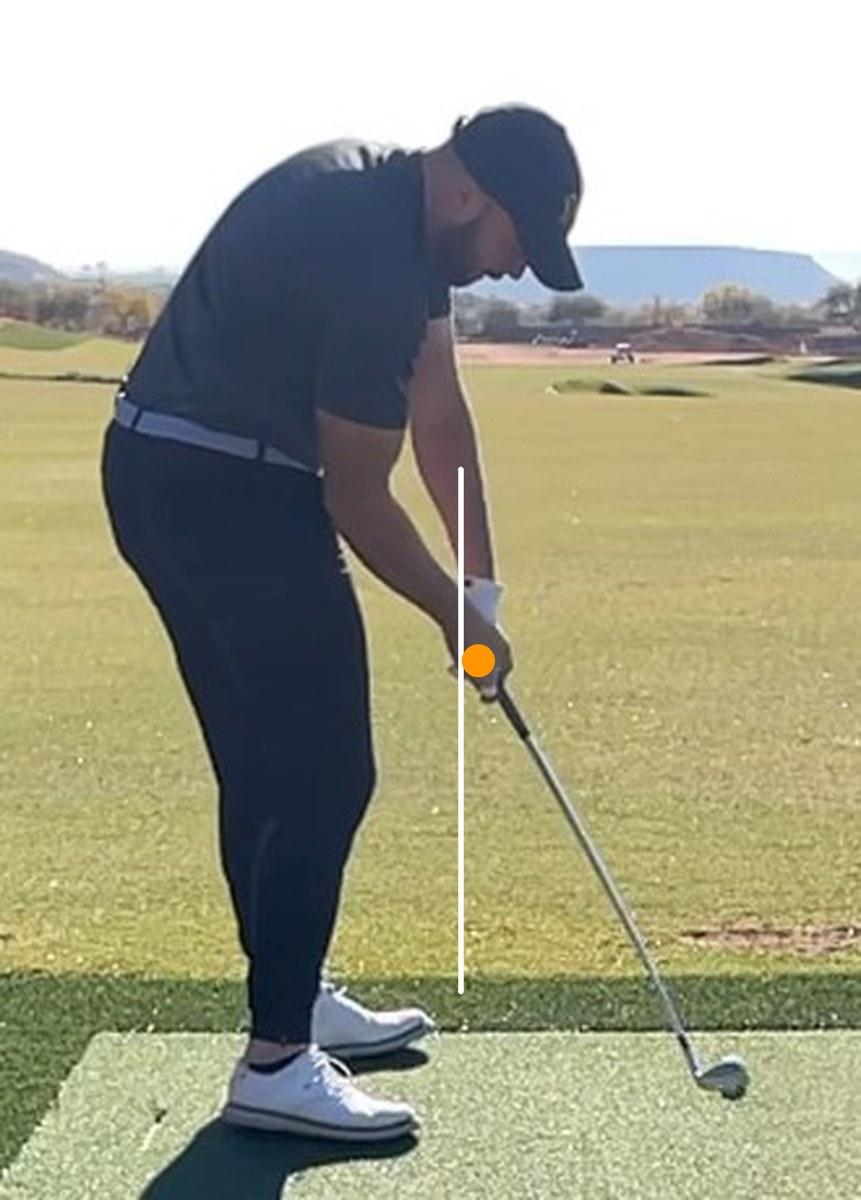
- Picture a line straight down through your hands at address.
- In this swing, at impact, the hands are back about on that line.
- Hands that come back closer to your body than at address bring the clubhead closer to you, toward the toe.
A swing that does this well
Understanding the idea.
The toe is the end of the clubhead farthest from you. On a toe strike the ball meets the face out there, away from the middle. With an iron the shot tends to come off weak and short, and it can feel dead in your hands. With a driver or wood, a toe strike can also change how the ball curves.
At address the middle of the face sits behind the ball. If the club comes back closer to your feet than it started, the middle slides inside the ball and the toe hits it. Several moves can bring the club in. Your hands and arms can pull in toward your body through the strike. Your lead arm can bend through the strike. Your body can rise out of its forward bend so the arms come up and in. Or you can back away from the ball. The look in this guide follows the hands, because the hands carry the club. If your hands come back closer to your body than at address, the clubhead comes closer too.
Standing too far from the ball at address can add to it, because your arms have to reach and tend to pull back in. That's a setup question, and the address posture guide covers it.
Impact tape or face spray shows where the ball met the face. Check it first, because a strike low on the face can feel a lot like a toe strike. Down the line is the view to use for the movement, because it shows how far you are from the ball.
How to read this pattern.
Your hands at impact don't need to come back to exactly their address spot. Many swings that strike the middle of the face show the hands a little higher at impact than at address, because the body has turned and the shaft has leaned. The comparison is a reference. It isn't a target to match.
A few toe strikes in a bucket are ordinary. It's worth working on when the marks gather toward the toe session after session. Shanks are the opposite strike, off the heel and hosel, and have their own guide. Mix up the two fixes and you can trade one miss for the other.
A practice cue.
Return the middle of the face to the ball.
Try the exercise.
Heel-side tee gate
Take a short iron onto grass. Set the club behind the ball with the middle of the face lined up with it. Push a tee into the ground just inside the heel, on the side of the ball nearest you, so only its head shows above the grass. Leave a small gap between the heel and the tee.
Make half swings at an easy pace. Hit the ball and leave the tee standing. If the club clips the tee, it came back closer to you than it started. Make the next swing smaller. Don't push your hands out at the ball, because that can swap a toe strike for a shank.
Spray the face or use impact tape so each strike leaves a mark. When the tee stays up and the marks move toward the middle for five swings in a row, make the swing longer.
What to record
After each set, note whether the tee stayed up and where the marks sat. A useful result is marks moving from the toe toward the middle without jumping to the heel.
Practice set: Make 3 sets of 5 half swings, then 2 sets of 5 three-quarter swings, checking the tee and the mark after each ball.
Keep in mind: Send the middle of the face back to the ball, clear of the tee.
Review the result.
For a practice comparison, record 5 partial short iron swings from a down-the-line view. Use the same setup for both sets; label shorter drill swings separately.
To check it on your own video, film down the line. Set the camera at about hand height, on the target line behind your hands, with your whole body and the ball in the shot. Pause at address and picture a line straight down through your hands. Step through the downswing to impact, one frame at a time near the ball, and note where the hands are against that line. In a swing that does this well, the hands come back about on the line, or a little above it, and the forward bend from address is still there. Hands that have come in closer to your body than the line, often with the chest and head rising, are the picture that tends to go with a toe strike. Look at three or four swings and pair each one with its strike mark.
Compare down-the-line video of ordinary shots before and after practice, with the camera in the same place. Pause at address and at impact, and compare where your hands sit against a line straight down from their address spot. Check that against the strike marks. You want the marks moving toward the middle. Matching an outline isn't the point.
If the marks jump from the toe straight past the middle to the heel, you've gone too far. Shorten the swing and look for the middle again.
Watch these clips.
These demonstrations offer another way to understand the idea. Each video opens at the selected starting point and continues playing; use the note below it to focus your viewing.
Martin Hall shows drills aimed at moving the strike off the toe.
The lesson sorts out causes that differ between higher and lower handicaps, then gives a drill for the feel of a centered strike.
The examples show body height and direction changing through the downswing. Rising out of the forward bend is one way the club can come back closer to you. Judge it with the strike marks. Not every upward movement hurts.
Seen down the line, a reference line compares a swing that keeps its forward bend into impact with one that rises out of it. Rising lifts the arms up and in, which is one way the club comes back closer to you.