
Down-the-line
Shanks (hosel strike).
When the ball shoots off sharply sideways, you've likely caught it off the hosel, where the shaft meets the clubhead. Often the club has come back to the ball farther from you than it started. Swing the clubhead back through the spot where it started at address.
By Dwain Kinghorn · Updated
Down-the-line · Address, Halfway down, Impact
What to look for.
- Camera view
- Down-the-line
- Where to pause
- Impact, compared with address
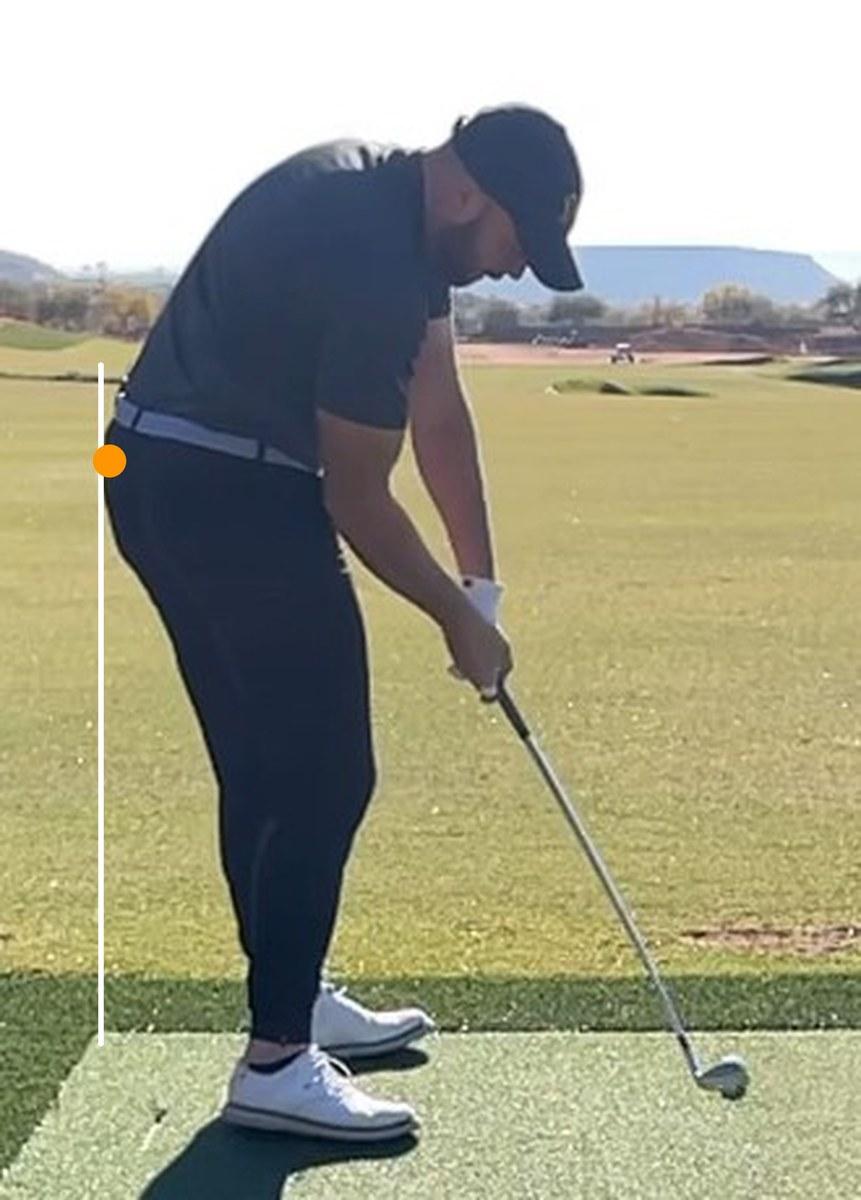
- Picture a line straight down from your seat at address.
- In this swing, at impact, the seat is still about on that line.
- Hips that move toward the ball can carry the club out, farther from you, and are often seen with a strike off the hosel.
A swing that does this well
Understanding the idea.
The hosel is the part of the clubhead closest to you at address. You shank it when that neck meets the ball instead of the face. For a right-handed golfer the ball shoots off low and to the right. For a left-handed golfer it goes left. A shank can show up out of nowhere after a run of good shots, which is part of why it feels so unsettling.
The geometry is simple even when the cause isn't. At address the middle of the face sits behind the ball. If the club comes back to the ball farther from your feet than it started, the face slides past the ball and the hosel hits it. Anything that moves the clubhead out between address and impact can do that. Your body can move toward the ball coming down, your hands can work out away from you, or your balance can drift onto your toes. Moving toward the ball coming down is the picture most often seen with hosel strikes. It's a pattern worth checking. It doesn't prove the cause in any one swing.
Impact tape or face spray shows exactly where the ball met the face. Use it before you decide it's a shank and not a heel strike or a push. Video answers the next question: what changed between address and impact that could have moved the club out. Down the line is the view to use, because it shows how far you are from the ball.
Shanks often come in streaks, and your first reaction can make them worse. Standing much farther away, or steering the club in at the last moment, tends to bring new misses. Sort out where you struck it from how you moved before you change anything.
How to read this pattern.
Some movement toward the ball is normal. The body turns and the hips change shape as you swing through, so a down-the-line impact frame will rarely match address exactly. What matters is whether the club has room to come back to where it started.
One shank doesn't define a swing. They show up most with wedges and short irons, where the ball is close and the swing is often partial. If the strike marks gather on the heel without reaching the hosel, the same check applies on a smaller scale. A toe strike is the opposite pattern and has its own guide. Mix up the two fixes and you can trade one miss for the other.
A practice cue.
Swing the clubhead back through the spot where it started at address.
Try the exercise.
Outside-headcover gate
Take a wedge or short iron and something soft, like a headcover or a folded towel. Set the club behind the ball as usual. Then put the headcover just past the toe of the club, on the far side of the ball from you, with a small gap.
Start with half swings at an easy pace. Hit the ball and miss the headcover. If the club touches it, the clubhead moved out on the way down. Make the next swing smaller and slower. Don't pull the club in at the last moment.
When five half swings in a row miss the headcover, go to three-quarter swings and leave the headcover where it is. Check the strike with impact tape or face spray every few shots, so you can see whether the marks are moving toward the middle of the face.
What to record
After each set, check the headcover and the strike marks. Count how many strikes reached the hosel or heel, and keep the gate in place until that count stays near zero.
Practice set: Make 3 sets of 5 half swings, then 2 sets of 5 three-quarter swings, checking the face after each set.
Keep in mind: Let the clubhead pass back through its starting spot, inside the headcover.
Review the result.
For a practice comparison, record 5 partial wedge swings from a down-the-line view. Use the same setup for both sets; label shorter drill swings separately.
To check it on your own video, film down the line. Set the camera at about hand height, on the target line behind your hands, with your whole body and the ball in the shot. Pause at address, picture a line straight down from your seat, and note where your hands are. Step through the downswing to impact. In a swing that does this well, the seat is still about on that line and the hands have come back about to where they started. A seat that has moved toward the ball, with the hands pushed out farther from you than at address, is the picture often seen with a shank. Look at three or four swings and pair each one with its strike mark.
Compare down-the-line video of ordinary shots before and after practice, with the camera in the same place. Pause at address and at impact, and compare how far your hips and hands are from the ball. Check that against the strike marks. If the picture looks closer to address but the marks are still on the heel, the change hasn't reached the strike yet.
A streak of shanks can end on its own, so judge it over a few sessions, not one bucket. If you're missing the headcover and the marks are moving toward the middle, the gate has done its job. Take it away and check that the strike holds.
Watch these clips.
These demonstrations offer another way to understand the idea. Each video opens at the selected starting point and continues playing; use the note below it to focus your viewing.
A lesson on what tends to send the club out toward the hosel, with a focus on the takeaway. Use it alongside your strike marks.
The line behind the pelvis makes movement toward the ball coming down easy to see, and that's the picture often seen with hosel strikes. The video is about early extension. Use it to see the movement. It doesn't prove what caused a shank.
A line behind the hips, down the line, compares a swing where the pelvis moves toward the ball with one where the hips keep their depth. Watch how much room the club has to come back to the ball.