
Face-on
Off-center strike.
When your ball comes off the toe or heel, it leaves slower than the same swing would send it from the middle. You can swing just as hard and still come up short. Spray the face, read the mark after each ball, and work the next one toward the middle.
By Dwain Kinghorn · Updated
Face-on · Club in frame · Address, Impact, Follow-through
What to look for.
- Camera view
- Face-on
- Where to pause
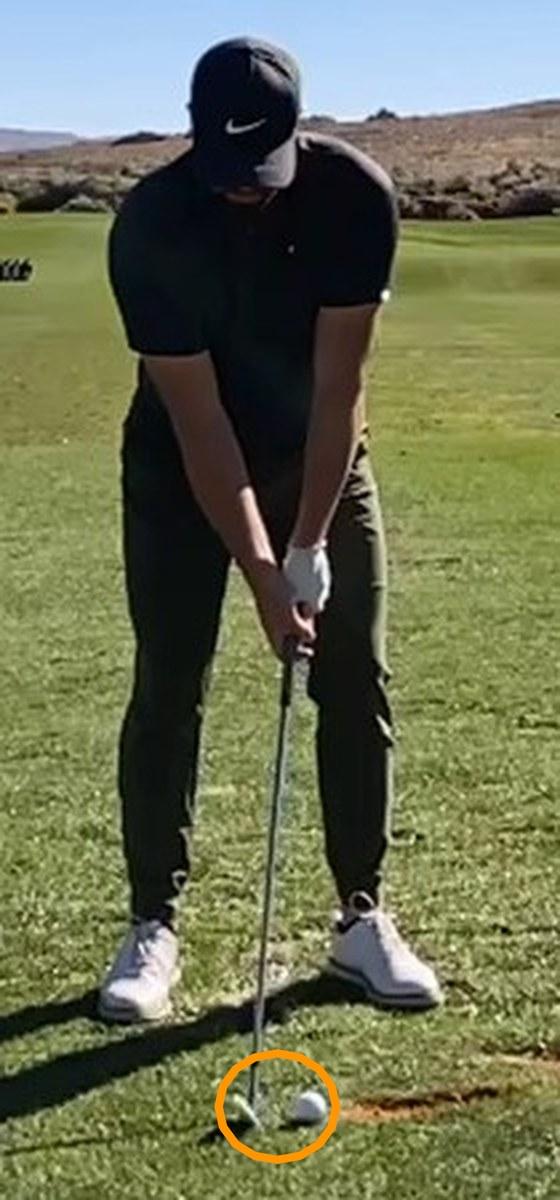
- Address, before the club moves
- Look at the clubhead and the ball, circled.
- In this setup the clubhead sits right behind the ball, ready to meet it.
- Impact tape or a face spray shows where on the face you actually strike it.
A swing that does this well
Understanding the idea.
The middle of the face is where the club passes its speed to the ball best. A strike toward the toe or heel lets the clubhead twist a little at contact, and the ball leaves slower than the same swing would send it from the middle. That's why you can swing just as hard and lose real distance. The speed was there. The strike wasn't.
With a driver or wood, an off-center strike can also change the curve. Keep that in mind when you read ball flight. A curve can come from where the ball met the face, not only from the face and path. Check the strike before you change the swing.
Impact tape, a face spray, or a launch monitor that reports strike location shows you where the ball met the face. Video answers the next question: what changed between address and impact to move the strike. If the marks sit on the toe, the toe strike guide covers the club coming back closer to you. If they sit on the heel or hosel, the shanks guide covers the club moving out.
Start with address. If you line the ball up with the toe or heel at address, a centered strike is less likely before you even swing.
On a launch monitor, the scorecard's strike location row reads the same thing as a number. It shows how far from the center the ball met the face, toward the toe or the heel in millimeters, and above or below the center. Positive offset is toward the toe, and positive height is above center. These read the same way for left- and right-handed golfers. With irons, most tour strikes on TrackMan fall between about 7 millimeters toward the heel and 6 toward the toe, the middle a little toward the heel. That's the middle 80 percent of the swings MotionEdge holds. It's a range, not a target. A strike off the toe or heel can change the curve, which is why it sits beside face to path on the scorecard.
How to read this pattern.
No golfer strikes every ball in the same spot. A cluster of marks around the middle is a good pattern. One mark on the toe isn't a project. Look at where the marks gather across a set.
Some golfers set up with the ball a little toward the toe or heel on purpose, for a particular club or shot. That's fine if the marks end up near the middle. Address is where you start. The marks are the result that counts.
A practice cue.
Put the strike mark in the middle of the face.
Try the exercise.
Heel, toe, middle ladder
Spray the face of a short iron with foot powder spray, or put on impact tape. Wipe it or replace it after each shot so you can read every mark.
Make half swings. Hit one ball trying to strike it toward the heel side of the middle, one toward the toe side, then one in the middle. Check the mark after each. If a heel attempt reaches the hosel, stop hitting heel balls and keep going with toe and middle only.
You're after control here, not perfection. If you can move the strike on purpose, you'll have an easier time finding the middle. After a few rounds, hit five balls aiming only for the middle and count how many marks land there. Move on when most of the five marks land in the middle.
What to record
Tally toe, middle and heel for each set. Keep the tally from session to session so the change is visible.
Practice set: Make 3 rounds of heel, toe and middle, then 2 sets of 5 balls aimed at the middle, checking the mark after each.
Keep in mind: Pick the spot on the face before you swing, and let the next mark land on it.
Review the result.
For a practice comparison, record 5 partial short iron swings from a face-on view, keeping the club in frame. Use the same setup for both sets; label shorter drill swings separately.
Keep a simple tally for each set: toe, middle, heel. You want more marks near the middle on ordinary swings. If you film face-on, pause at address and check where the ball sits against the face.
The payoff is distance on centered strikes. Judge it with the same club and target before and after, and compare the whole set. The one longest ball doesn't count for much.
Watch these clips.
These demonstrations offer another way to understand the idea. Each video opens at the selected starting point and continues playing; use the note below it to focus your viewing.
Impact tape and foot powder spray compared as ways to see where the ball met the face. That's the feedback this guide's drill uses.
The strike discussion treats contact location as part of a good impact. A good-looking body position doesn't guarantee the ball met the center of the face.