
10 of 10
Finish.
Finish is the end of the swing as the motion settles. Use it to review balance and completion, without assuming a trophy pose proves a good strike.
By Dwain Kinghorn · Updated
A finish shows balance, not the strike.
At the finish the motion is settling. Use it to review balance and completion, without assuming a good-looking finish proves a good strike.
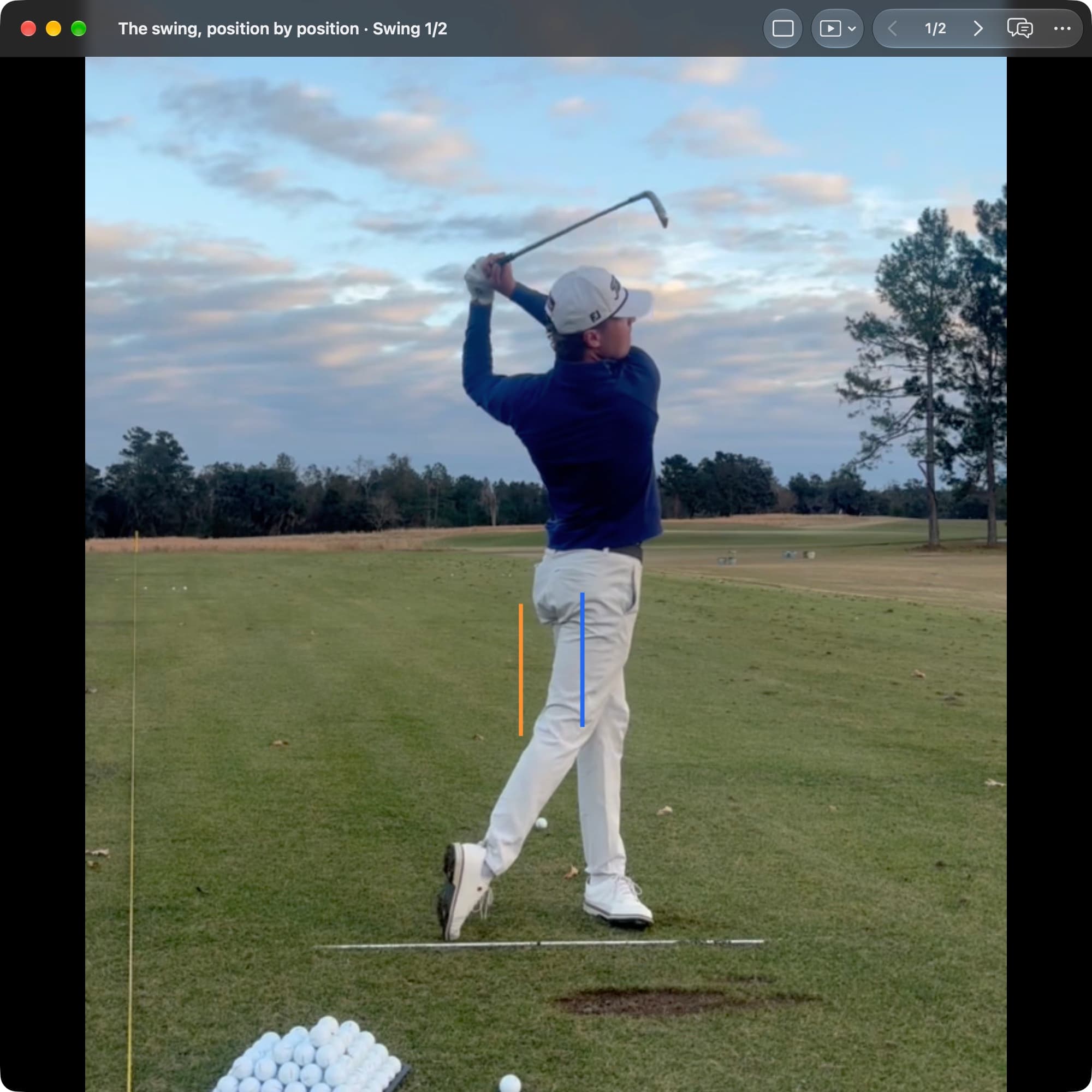
Face-on
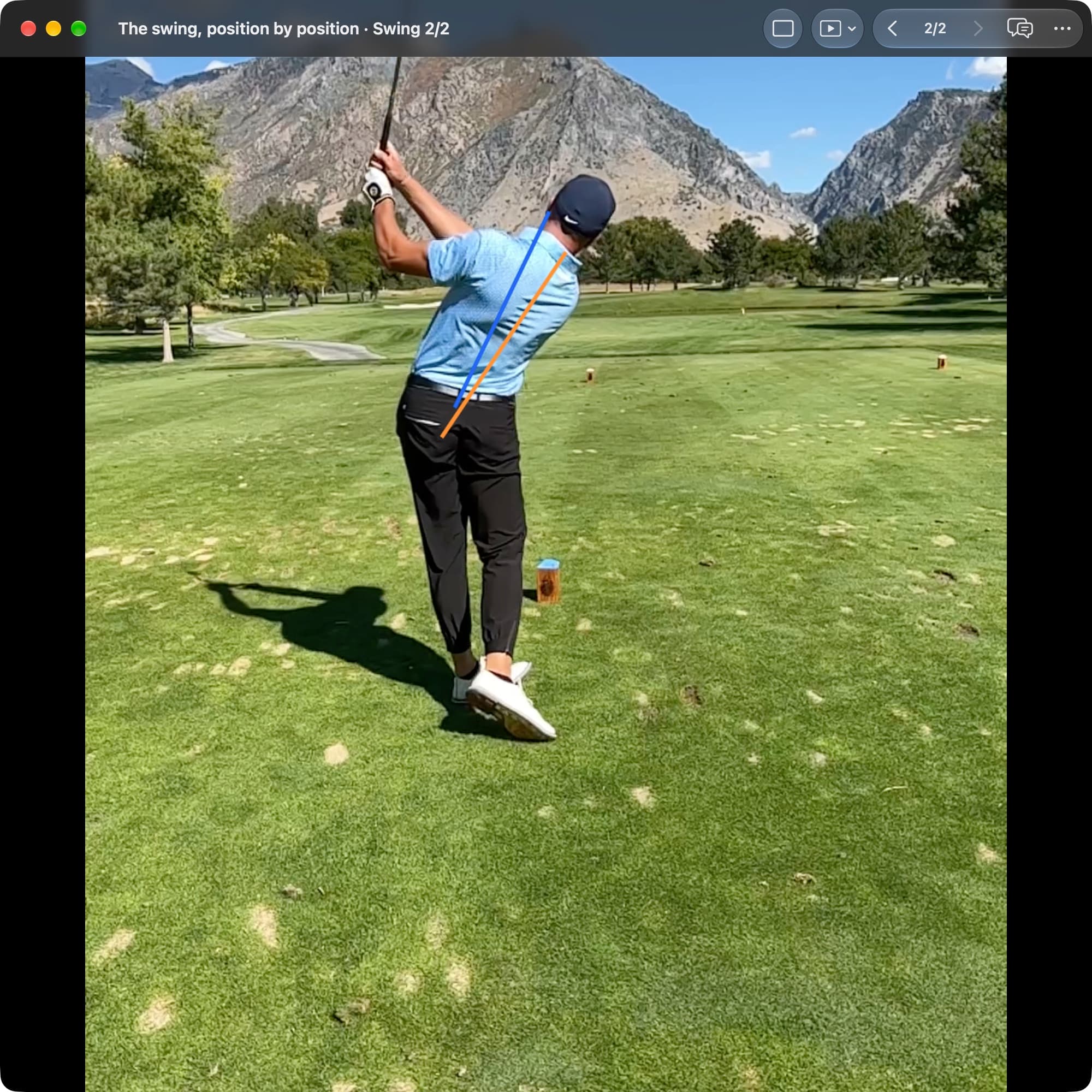
Down-the-line
Judge the finish by comfort and balance. If the question is about moving toward the ball earlier in the swing, look at the delivery frames rather than the finish.
Try this view with your own swing
- Choose the frame. Open the swing in Video Player and use Jump to position to select Finish. Step a frame either way to see the motion around it.
- Check balance. Turn on both the Setup and Live toggles for Hip Center Line in a face-on recording to see where the pelvis finished relative to Address.
- Hold it. A finish you can hold for a moment is a useful practice check. Do not force a position that is uncomfortable.
Understanding this position.
The club and body slow after the ball has gone. A finish can show whether the golfer completed the chosen motion comfortably or needed a stumble, step, or abrupt recovery. It is often easier to observe at normal speed than the brief delivery into impact.
The finish is still only an outcome of the movement. A golfer can hold an attractive pose after a poor strike, and a deliberate step-through drill can finish outside the original stance. Read the situation before deciding that the final position is evidence of a fault.
How to read the position.
Full swings commonly finish more supported by the lead side, with the chest turned toward the target and the club around the body. Exact hand height, club location, and amount of turn vary with flexibility, club, and intended shot.
A short punch or partial wedge may finish lower and shorter. A player with limited comfortable rotation need not force the club behind the neck. The useful reference is a finish reached without unnecessary strain or an unplanned scramble, not a pose held for its own sake.
Read each camera view.
Face-on
Notice where the hands and club settle after the motion slows. They may finish high, lower, or more around the body depending on the shot.
What this view can show.
- Hands and club
- Notice where the hands and club settle after the motion slows. They may finish high, lower, or more around the body depending on the shot.
- Wrist and clubface
- The wrists have completed much of the release and fold. Their final shape does not reveal the exact face orientation that existed at impact.
- Shaft orientation
- The club may wrap behind the back or stop shorter. A shaft position over the shoulder is common, not a requirement for every shot.
- Pelvis and space
- The pelvis often faces more toward the target than at Address. Judge comfort and balance rather than a required amount of final turn.
- Chest and shoulders
- The chest has continued through the shot. How far it turns depends on the motion and the golfer; do not force additional rotation after the swing ends.
- Body rotation
- The chest and pelvis need not finish perfectly square to one another. A final relationship cannot establish the quality of the earlier sequence.
- Feet and balance
- Observe whether the finish is supported without an unplanned fall backward. A deliberate step-through task should be identified before treating a step as instability.
Video shows foot movement and balance, not pressure distribution or ground-reaction force.
Down-the-line
Look at the club settling naturally around the body. Its final position should not be manufactured after the shot merely to improve the picture.
What this view can show.
- Hands and club
- Look at the club settling naturally around the body. Its final position should not be manufactured after the shot merely to improve the picture.
- Wrist and clubface
- The clubface is no longer a useful impact reference. Do not infer a hook or slice from the direction it points after the motion stops.
- Shaft orientation
- Finish height and shaft direction vary with the club and shot. A shorter finish can be intentional rather than evidence of deceleration before impact.
- Pelvis and space
- Standing taller is normal now. Compare with the delivery if the question concerns early movement toward the ball rather than this final outline.
- Chest and shoulders
- Observe whether the torso completes the intended motion comfortably. A restricted or painful finish should not be forced to match a reference.
- Body rotation
- The body has slowed, but this picture cannot reveal the timing of those speed changes. Review normal-speed playback for the overall continuity.
- Feet and balance
- Watch for tipping toward the ball or falling away while the motion settles. The image shows balance behavior, not pressure percentages or ground forces.
Video shows foot movement and balance, not pressure distribution or ground-reaction force.
Review balance alongside contact and the intended shot. A finish that arrives naturally is useful feedback, but it does not guarantee a centered strike or a suitable clubface. Return to the earlier frames if those questions remain.
If practicing a balanced finish, begin with short shots and let it emerge from the motion. Avoid adding a pose after the ball leaves. Compare several attempts, including ordinary misses, to see whether the task improves the swing rather than only the final photograph.
Watch these clips.
Use these demonstrations to put the still into motion. Each video opens at the selected starting point and continues playing; the note below explains its relevance to this position.
The finish task makes balance easy to observe. Let the position emerge from the swing instead of adding a held pose afterward.
The contrasting movements give context for a finish that falls away from the target. Check the preceding delivery before deciding that the finish diagnoses hanging back.